
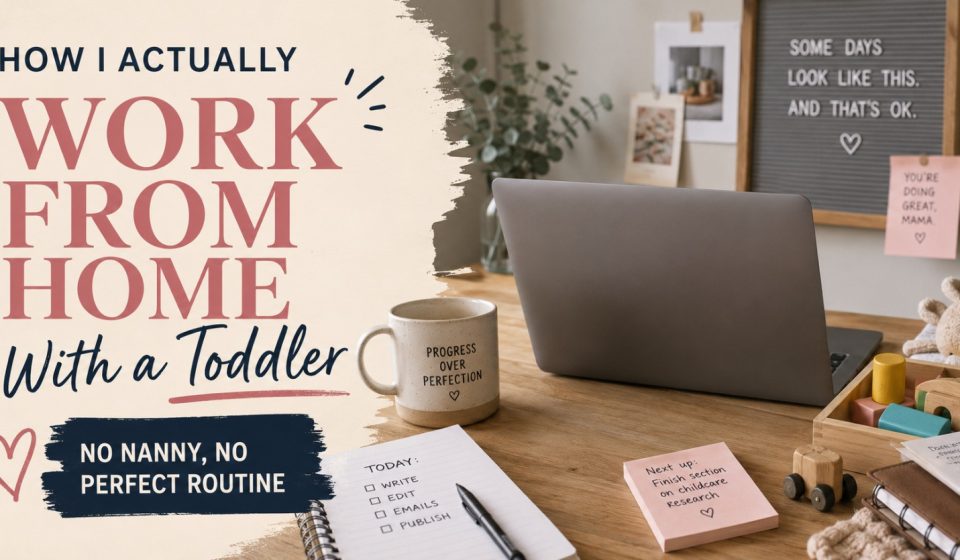

Before you begin, this is a working mother narrating how work actually happens, not a productivity expert promising that the right routine makes childcare and full-time work effortless.
Can you really work from home with a toddler and no childcare?
Yes! But it does not look like the work-from-home routine you see on Instagram. There is no organised desk, no uninterrupted morning, no blocked eight-hour day. There is me, my laptop, a list that never gets shorter, and a toddler who needs me exactly when I need to concentrate. In the middle of a sentence, I will hear “Mumma,” and by the time I have given water, found a lost toy, and sat back down, the sentence is gone.
I do not have a nanny or household help; I am a writer who works from home while raising my kids. This isn’t a productivity formula; it’s what I’ve learned about getting real work done when the workday shares space with actual family life.
The Perfect WFH Setup Doesn’t Exist
Most productivity advice assumes that when you’re working, you’re actually working. That’s not possible with a toddler around. Research on remote-working parents backs this up: WFH tends to increase the overlap between paid work and childcare, with parents supervising, multitasking, and reshaping schedules around care demands as they go. That doesn’t make it a bad idea; it just means the workday looks different. Productivity stopped being about protecting eight perfect hours and became about using the hours I actually get.
I Stopped Planning the Day Like a 9-to-5
I used to treat a workday as one long block: sit down, work, finish. That falls apart with a toddler in the house. Now I think in windows: an hour here, thirty minutes there, sometimes just fifteen. Instead of asking when I will get four uninterrupted hours, I ask what I can finish in the time I have and match the task to the window. A quiet stretch goes to writing or research; a stretch likely to be interrupted goes to email, proofreading, formatting work I can pick up and put down easily.
For a writer, thirty uninterrupted minutes can outweigh an hour of constant interruption. Writing means finding the right point, connecting ideas, working out how a paragraph should open that takes mental space you can’t build in fragments. Whenever a predictable quiet period shows up like nap time, early morning, after everyone’s asleep, it goes to the hardest work on my list, and I decide what that is before the window opens, so I’m not burning the first fifteen minutes hunting through notes.
The Hidden Cost of a “Five-Minute” Interruption
An interruption rarely costs only the time it takes. Ten minutes helping my elder daughter find a toy also means coming back, rereading the last paragraph, and rebuilding the thought mid-way through; that’s the restart cost, and for focused work it’s steep. I don’t treat every fifteen-minute gap as interchangeable: with a warmed-up brain, fifteen minutes is genuinely useful; right after an interruption, it may only get me back to where I was.
I have also let go of needing to entertain my toddler every minute I’m working. Kids have stretches of independent play, and I use those when they show up rather than expect them on schedule. My routine is a plan, not a contract.
What I Do When the Day Falls Apart
Some days it just happens: no nap, a clingy toddler, a looming deadline, a bad night’s sleep. I used to let a disrupted morning write off the whole day. Now I focus on the next useful window instead of the hours already lost: if I can’t write, I edit; anything urgent moves to the top; on the worst days, very little gets done, and that’s fine. A system that only works when everything goes according to plan is not much of a system, and something has to be left out if work gets done and the house doesn’t look it, or the house gets caught up and work happens later than planned. The research agrees: remote work consistently blurs the line between paid work and care, with parents adapting schedules and multitasking to hold both together. I make a daily list about what matters most right now.
Three Things That Actually Help
I always leave myself the next task. I do not leave while writing an article; I try to finish the section on childcare research. So I can be specific enough to start the second a window opens.
I separate deep work from easy work. Quiet windows go to thinking and writing; interruption-prone stretches go to anything that survives being paused.
I have a minimum successful day. One question I always carry in mind is what has to happen today, and once that’s done, everything else is a bonus, not a failure.
Can You Actually Be Productive With a Toddler at Home?
Yes, but not easy at all. The research does not offer a clean verdict on remote-work productivity; it depends on the job. One notable data point: an NBER randomised experiment with data-entry workers in India found that those working from home were 18% less productive than their office-based counterparts, pointing to attention constraints at home, including care responsibilities, as part of the explanation. That doesn’t mean everyone loses a fifth of their output.
Even so, I would choose this setup again. No commute, and I am around for my kids. I can move work around family needs more often than I have to bend family needs around a rigid schedule, and that’s worth more to me than a tidier calendar. Research backs the upside too: WFH is linked to real work-life-balance benefits for parents, though it varies with childcare demands. But flexibility isn’t free time; it doesn’t remove childcare or housework, it just gives me more control over where, and sometimes when, I do the work. That control is worth something, even on the days it doesn’t feel like it.
My children’s needs change, my workload changes, deadlines shift. So I have stopped chasing a routine that holds steady and started building one that can bend. A good day means finishing an article; another might mean just one hard section, or the urgent thing done, or admitting today was difficult and starting fresh tomorrow. No trick turns childcare into uninterrupted work time, just knowing the work that needs doing, looking honestly at the time I have, and making the two fit as well as I can. I don’t need to look the same for the work to matter.
Frequently Asked Questions
Can you work from home with a toddler and no childcare?
Yes, depending on your job, working hours, flexibility, and how much supervision your toddler needs. But working from home isn’t a substitute for childcare; it just gives you more control over how the two overlap.
How do I work from home when my toddler keeps interrupting me?
Match tasks to your available attention. Save quiet periods for deep work, and use interrupted stretches for emails, proofreading, and other tasks that are easy to pause and resume.
How can I get focused work done with a toddler at home?
Identify your most predictable quiet period and protect it for your most important task. Decide what you’ll work on before that window opens, so you can start immediately.
What should I do if my toddler doesn’t nap?
Don’t build your whole workday around nap time. Shift deep work to another reliable quiet period and use shorter windows for lighter tasks.
Is working from home more productive for parents?
There is no universal answer. It can offer flexibility and better work-life balance for some parents, while childcare responsibilities can also create interruptions, multitasking, and shifting schedules that cut into output.
Do I need childcare if I work from home?
Not necessarily, but working and providing childcare are two separate responsibilities. The more meetings, focus, and fixed hours your job demands, the harder it becomes to do both at once.



[…] going to hand you the soft-focus version. My schedule is relentless. Work does not pause because toys are scattered across the floor again, or her plate is still sitting on the table instead of the sink, or she has not had enough […]
[…] this resonated, you may also want to read what I’m unlearning as a working mom of two, how I actually work from home with a toddler, or the 5 AI tools I use every day as a working […]