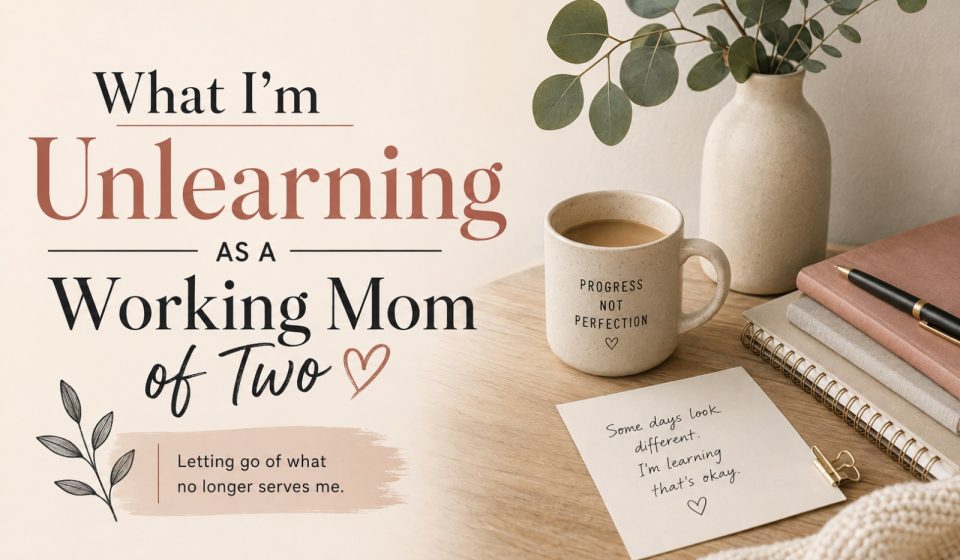

For a long time, I thought personal growth meant adding something like a new skill, a better routine, more discipline, a smarter way to manage my time.
Then I had children. Eventually, I became a mother of two who was also trying to keep working.
Somewhere between deadlines, school timings, meals, laundry, a toddler asking me the same question five times, and a baby who needs me the exact moment I sit down to work, I started wondering if I needed to learn anything else at all. Maybe I need to unlearn a few things: doing everything with perfection, the guilt of sitting down, the idea that asking for help means I can’t handle things, the expectation that work, children, home and I can all get 100% of me on the same day.
I’m still figuring it out. But these are the things I am trying to let go of.
Why “Unlearning” Feels More Honest Than Self-Improvement
There is no shortage of advice on becoming a better version of yourself: wake up early, plan the night before, exercise, journal, meal prep, set boundaries. I have tried plenty of it. But most of it left me with the same uncomfortable thought: maybe I am doing something wrong, because my life still feels messy.
Motherhood made me question that. Maybe my life is not messy because I have not found the perfect system. Maybe I am simply trying to fit too many things into one day.
The numbers back that up. Pew Research Center’s 2026 research found that 81% of full-time working mothers surveyed handle parenting tasks while working at least sometimes, and 62% said balancing work and family responsibilities is difficult. So I’ve stopped asking why I can’t balance everything perfectly, and started asking a different question: does everything actually need to be balanced?
Unlearning Perfectionism at Work
This one has been uncomfortable. I have spent years as a writer and editor, so noticing what’s wrong comes naturally: a sentence could be cleaner, a headline sharper, a paragraph could flow better. There is always another edit. When you are used to working that way, “good enough” can feel suspiciously close to lazy.
Motherhood has forced me to reconsider. Some days I get a small window to work, the children need something, the house needs something, and I have already been interrupted four times. At some point I have to stop polishing and say: this is good, I am done. That does not mean I care less about the work; it means I have accepted that not every piece deserves the last 10% of my energy.
The broader research backs this up. The American Psychological Association notes that unrealistic expectations and excessive pressure contribute to parental burnout. So I hve started replacing one question with another. Instead of “can I make this better?” I ask: “Does making this better actually matter?” Sometimes it does. Sometimes it really doesn’t.
Unlearning the Guilt Around Rest
This one sounds simple until you try it. I can sit down with a cup of tea and, within five minutes, start mentally listing everything I have not done the dishes, the laundry, that email, something for the children, something I forgot completely. Rest starts to feel like a luxury I have not earned.
But if I wait until everything is finished before I rest, I know exactly what happens: I never rest. I’m apparently not alone here: Pew’s 2026 research found that 67% of full-time working mothers surveyed said they don’t have enough time to relax, and 74% said they don’t have enough time for hobbies or interests.
That number made me stop. Maybe the answer is not another self-care routine. Maybe I just need to stop treating rest as something that has to be justified. I’m still learning how to do that.
Unlearning I Will Just Do It Myself
This is probably the habit that causes me the most trouble. Doing something myself is often easier in the moment; I know how I want it done, I know where everything belongs, I do not have to explain anything. So I do it, then the next thing, then the next, until I’m wondering why I’m exhausted.
The problem is that once you always say I will just do it, everyone gets used to you doing it. Pew’s data shows how uneven this becomes: among households where both parents work full time, 52% say mothers do more day-to-day parenting and 43% say mothers do more household chores.
So I’m trying to unlearn the idea that being capable means being responsible for everything. Sometimes being capable means saying I can’t take this on too and letting someone else handle it, even if they don’t do it exactly the way I would. That last part is harder than it sounds.
Unlearning the Idea That Every Day Has to Be Balanced
I used to picture a balanced day as a productive workday, quality time with the children, a reasonably clean house, a proper meal, some exercise, time with my husband, and ideally a little time for myself. Where exactly was I planning to find those extra hours?
Real life does not divide that neatly. Sometimes, work gets more of me, and some days the children do. Some days the house loses completely, and the biggest achievement is getting everyone fed, dressed, and through bedtime without losing my mind. I’m learning not to call those days failures. A successful day does not have to be split across every part of my life; sometimes it just means knowing what matters most today.
Unlearning the Word Should
I have started noticing how often I say it to myself: I should exercise, I should cook something healthier, I should spend more time with the children, I should keep the house cleaner, I should be more present. It’s a surprisingly heavy little word.
Psychologists point to the same pressure: the APA recommends questioning the “shoulds” that add unnecessary weight to an already demanding job. Now, when I catch myself saying it, I try to stop and ask: does this actually matter right now? Sometimes yes. This is not just something I think I’m supposed to care about.
What I’m Building Instead
Unlearning sounds negative, but I’m not trying to care less; I am trying to make room for a different way of doing things.
| Letting go of | Trying instead |
| Perfect work | Work that’s good and finished |
| Guilt about rest | Resting before I’m completely exhausted |
| Doing everything myself | Sharing responsibility |
| Perfect daily balance | Deciding what matters today |
| Being available all the time | Clearer boundaries |
| Endless “shoulds” | Asking what actually matters |
| Proving I can handle everything | Admitting when I need help |
I am not particularly good at any of this yet. There are still days I try to control everything, still days I feel guilty for resting, still days I take something back because it would have been quicker to do it myself. I am not writing this from the other side of the problem; I am writing from somewhere in the middle of it.
Maybe Motherhood Is Not About Becoming More
This is the part I keep coming back to. Before children, I thought growth was mostly accumulation: more knowledge, more skills, more discipline, more productivity. Motherhood has shown me growth can also be subtraction: removing the expectation that the house should always be tidy, the guilt from sitting down, the pressure to answer every message immediately, the belief that my children need a perfectly organised mother, the need to prove I can manage everything alone. And maybe, most of all, removing the idea that my worth is measured by how much I got done today.
I still want to work. I still care about doing good work. I have nott stopped being ambitious. I just do not want ambition to require me to disappear from my own life.
I’m Still Unlearning
I do not think this is something I will finish. There will probably always be another expectation to question, another habit I picked up without noticing, another version of “perfect” to let go of.
But I am beginning to understand something I didn’t before: I don’t have to do everything well to have a good life. I just need to know what deserves my energy, and what doesn’t.
My older daughter is turning four soon, and I’ve been thinking about the last four years, the woman I was before she arrived, the mother I became after, and everything I thought motherhood would teach me. Four years ago, I thought becoming a mother would teach me how to become more. Instead, slowly and sometimes painfully, it’s taught me what I can let go of.
And lately, I have found myself thinking about one particular day, the day this whole chapter began.
Frequently Asked Questions
What should working moms unlearn? Common habits worth questioning include perfectionism, guilt around rest, doing everything yourself, constant availability, and the expectation that work and family should always be perfectly balanced.
Why do working moms feel guilty? Working mothers face competing demands from work and family. Pew’s 2026 research found that 62% of full-time working mothers surveyed said balancing work and family responsibilities is difficult.
How can a working mom stop being a perfectionist? Separate genuinely important standards from unnecessary perfection. Decide what “done” looks like before starting a task, and notice when extra effort no longer creates meaningful improvement.
Is it okay for working mothers to rest?
Yes. You do not earn rest after every responsibility is complete. Many working mothers already report not having enough time to relax.
How can working moms reduce their mental load? Identify what you’re carrying unnecessarily. Share recurring responsibilities, simplify routines, use systems to remember information, and stop treating every task as equally urgent.
Is work-life balance realistic for working mothers? Perfect balance every day is probably unrealistic. A more useful goal may be flexible priorities — deciding what deserves your attention during a particular day or season.



[…] this resonated, you may also want to read what I’m unlearning as a working mom of two, how I actually work from home with a toddler, or the 5 AI tools I use every day as a working […]